15 min read · Updated September 2026
Umrah cost from the USA: package prices and the DIY route

Published September 3, 2026 · 15 min read

American Muslims planning Umrah face a wider spread of prices than almost any other departure country, mostly because of geography. A flight from New York to Jeddah is a different budget line than one from Los Angeles or Houston, and unlike UK or European pilgrims, there is no single ABTA-style trade body vouching for US Umrah operators, which makes vetting one yourself more important, not less.
US citizens are eligible for the Saudi tourist e-visa, the same one that opened Umrah to independent travel for British and many other passport holders. That means booking your own flight, your own hotel, and your own transport between Jeddah, Makkah and Madinah is entirely legal, and for a comfortable, organized traveler it can meaningfully undercut a packaged trip. Most first-timers still choose a package, largely for the logistics, and that choice is reasonable, but it should be an informed one.
This guide breaks down both paths in real 2026 numbers, in US dollars, departing from the American cities Umrah groups actually fly from.
The short answer
- Budget package (10-14 days)
- $1,800 to $2,300 per person
- Standard package
- $2,800 to $3,400 per person
- Premium package (Haram-view hotels)
- $4,500 and up
- DIY route (self-booked e-visa + flights + hotels)
- $1,500 to $2,100 per person
- Exchange rate
- $1 = SAR 3.75 (fixed peg, does not float)
- Cheapest months
- Muharram, Safar, and late summer outside US school breaks
Two routes: the US Umrah operator or the self-booked e-visa
American citizens sit on the list of nationalities eligible for the Saudi tourist e-visa, applied for directly through the Saudi e-visa portal or the Nusuk platform. That visa covers Umrah as well as general tourism, meaning a US traveler can book their own return flight, their own hotel on Booking.com or Agoda, and their own transport between cities without ever contacting a tour operator.
The more common route is still booking through a US-based Umrah travel agency, often one connected to a local mosque or a national chain with offices in cities with large Muslim communities such as Dearborn, Chicago, Houston, and Northern Virginia. There is no US equivalent of the UK's ATOL scheme, so financial protection comes down to how you pay and who you book with, not a regulatory backstop.
Neither route is wrong. Groups traveling with elderly parents or young children generally find a package worth paying for simply because someone else handles the visa paperwork, the airport pickup, and the bus between the two holy cities. A traveler comfortable with Nusuk, hotel booking sites, and the Haramain train can do it independently for less.
What a US Umrah package actually costs, tier by tier
Package prices from the US cluster into three tiers, and hotel distance from the Haram explains most of the gap between them, exactly as it does from every other departure country. A ten to fourteen day trip covering both Makkah and Madinah is the standard length most American operators sell.
The figures below cover a fourteen day trip, per person, sharing a room with one or two others, booked eight to ten weeks ahead. Solo travelers needing a single room typically add thirty to fifty percent to the accommodation lines, and prices vary somewhat by departure city; a Chicago or Houston fare often lands ten to fifteen percent below one from Los Angeles or a smaller hub requiring an extra connection.
| Component | Economy | Standard | Premium |
|---|---|---|---|
| Return flight (JFK/ORD/IAH to JED/MED) | $950 | $1,150 | $1,550 |
| Umrah visa and operator service fee | $150 | $190 | $230 |
| Makkah hotel (7 nights, shared room) | $360 | $720 | $1,450 |
| Madinah hotel (5 nights, shared room) | $240 | $440 | $780 |
| Ground transport (Jeddah-Makkah-Madinah) | $90 | $120 | $165 |
| Food (14 days) | $180 | $270 | $410 |
| Connectivity (eSIM) | $20 | $32 | $48 |
| Total | $1,990 | $2,922 | $4,633 |
What the DIY e-visa route costs instead
Booking it yourself starts with the Saudi e-visa, applied for online in under fifteen minutes and typically approved within a few days, for a fee of roughly $140 that usually bundles the mandatory travel insurance the visa requires. From there you're pricing the same three components an operator bundles, flights, hotels and transport, without the markup on top.
A return economy flight on Saudia, Turkish Airlines, Qatar Airways, or Emirates from New York JFK, Chicago O'Hare, or Houston Bush Intercontinental to Jeddah runs $850 to $1,150 booked two to three months out. A budget hotel booked directly through Booking.com in Aziziyah, Makkah, a ten to twenty minute shuttle ride from the Haram, runs $28 to $42 a night, and a comparable Madinah hotel within walking distance of Masjid an-Nabawi runs $22 to $35 a night. The Haramain High Speed Railway between Jeddah, Makkah and Madinah costs SAR 105 to SAR 350 depending on class, roughly $28 to $93 one way.
Add it up over fourteen days and a self-booked economy trip lands around $1,500 to $2,100 per person, close to or slightly below the package economy tier, with the difference being your own research time and no organized recourse if a hotel booking or an operator falls through.
Choosing a legitimate US Umrah operator without getting scammed
With no ATOL-style scheme in the US, the checks shift toward the agency's accreditation and how you pay. Look for IATAN accreditation, the International Airlines Travel Agent Network's registry, which confirms the agency is a recognized travel seller rather than an informal broker operating out of a phone number. A Better Business Bureau profile with a real complaint history you can read is a second useful check most operators never volunteer.
Pay by credit card wherever possible rather than by wire transfer, cash, or a personal Zelle or Venmo payment. Credit cards carry chargeback protection if an operator fails to deliver, and that protection is close to the only financial safety net available to a US Umrah traveler outside of self-insuring the trip.
Get the exact hotel name in writing before paying anything, not just the neighborhood, and search it yourself. 'Walking distance to the Haram' on a flyer can mean anywhere from a five minute walk to a twenty-five minute shuttle, and a legitimate operator answers a direct question about the hotel name immediately.
Red flags that mean walk away
No IATAN accreditation and no verifiable business address. Payment requested only by wire transfer, cash, or a peer-to-peer app rather than credit card or the agency's registered business account. No written confirmation naming the hotel, dates and room type. A price 30 percent or more below every competitor for the same season. Any one of these is reason enough to choose a different operator.
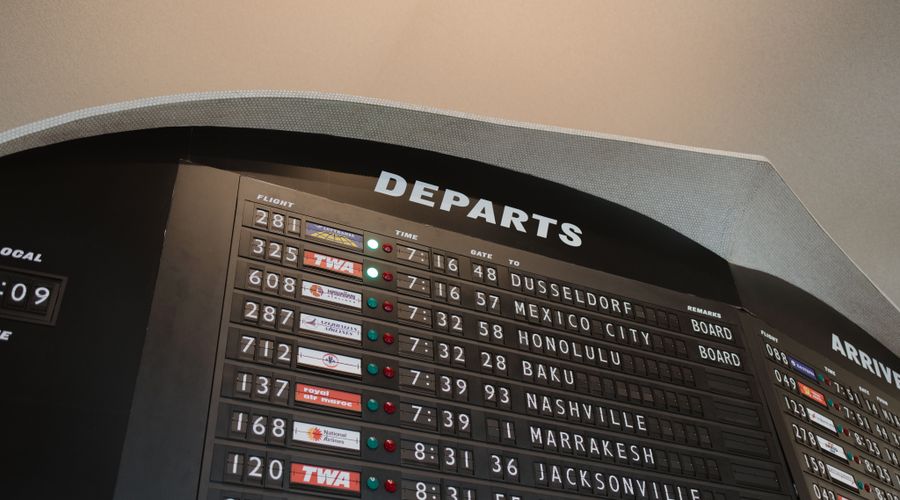
Flights: JFK direct, or a connection through the Gulf or Turkey
Saudia flies nonstop from New York JFK to Jeddah, the most direct routing available from the US, and the one most East Coast pilgrims default to. From Chicago, Houston, Los Angeles, Washington Dulles, and most other major American cities, the standard routing is a single connection through a Gulf or Turkish hub: Turkish Airlines through Istanbul, Qatar Airways through Doha, or Emirates through Dubai, each running competitively on price and occasionally undercutting a JFK departure once the domestic connecting flight is added in.
A one-stop routing through Istanbul or Doha adds real hours, typically five to eight beyond a direct JFK flight, but frequently saves $100 to $200 over piecing together a domestic flight to New York plus the nonstop segment. Families traveling with elderly parents or small children often find the extra hours a worthwhile tradeoff for a wider seat selection and a familiar airline.
Fares climb sharply in the weeks before Ramadan and across major US school breaks, particularly spring break in March and the winter holidays in late December. The lowest fares of the year tend to sit in the Islamic months of Muharram and Safar right after Ramadan, and again in late July and August once the peak of US summer travel eases.
Hotels: what the price tiers actually buy
Hotel distance from the Grand Mosque explains most of the price gap between tiers, and it is worth understanding in concrete terms rather than the vague marketing language every operator uses.
Economy tier hotels in Makkah sit in Aziziyah or the outer Al Ajyad district, ten to twenty-five minutes from the Haram by the free shuttle buses most operators run, or a comparable walk for a fitter traveler. Standard tier moves you into inner Al Ajyad or Ibrahim Al Khalil Road, a five to ten minute walk. Premium tier means the towers directly ringing the mosque, including the Abraj Al Bait clock tower complex, where the Haram is minutes from the lobby, at three to four times the room rate of economy.
Madinah is more forgiving on budget. The city is smaller and less congested than Makkah, and even economy hotels there typically sit within a fifteen minute walk of Masjid an-Nabawi, so upgrading buys less than it does in Makkah. Many American pilgrims do well spending more on Makkah proximity while keeping Madinah at the economy tier, where the walk stays manageable regardless of hotel class.
Money matters: the SAR peg, cards and cash
Unlike most currencies, the Saudi riyal is not a floating rate against the dollar. It has been pegged at SAR 3.75 to $1 since 1986 and the Saudi Arabian Monetary Authority holds that peg deliberately, so $1,000 converts to a fixed SAR 3,750 regardless of when you check, with none of the week-to-week movement travelers to Europe or the UK have to track.
That stability makes budgeting easier, but exchange fees still vary widely by where you convert. A no-foreign-transaction-fee credit card, such as those offered by Chase Sapphire, Capital One, or many credit union cards, gives close to the fixed rate on purchases with no markup. Withdrawing cash from a Saudi ATM using a fee-free debit card, such as Charles Schwab's checking account or a similar no-fee card, beats exchanging dollar bills at a Jeddah airport counter or a Makkah hotel desk, both of which apply a meaningful spread.
Cards work broadly across Saudi Arabia now, accepted for tap-to-pay at most hotels, restaurants and the Haramain train counters. Still, carry some cash for smaller vendors near the Haram, barbers, and Ziyarah taxi drivers in Madinah, many of whom deal in cash only.

Simple cash rule
Bring a no-foreign-transaction-fee card as your primary payment method, withdraw riyals from an ATM as needed rather than converting a large sum of dollars upfront, and keep no more cash on you at any one time than you would be comfortable losing. Split cash between carry-on and checked luggage rather than carrying it all in one place.
When to go: Ramadan, regular season and US school breaks
Ramadan carries the greatest spiritual reward, particularly the last ten nights, and also the sharpest price spike of the year. Hotel rates in Makkah during that period can run two to three times normal, flights sell out weeks ahead, and both package prices and DIY hotel rates rise in step. It is genuinely worth doing once, with the cost expectation set correctly from the start.
Outside Ramadan, the US school calendar matters more than most first-timers expect. Spring break in March and the two weeks around Christmas and New Year push family demand and prices up noticeably, since those windows let parents travel with school-age children without pulling them out of class. The Islamic months of Muharram and Safar right after Ramadan, along with late July and August once the peak of domestic US summer travel eases, see the lowest prices of the year.
For a pilgrim optimizing purely on cost, avoiding both Ramadan and the two major US school break windows can save $150 to $300 per person on an otherwise identical trip.
What's included, and what quietly isn't
A legitimate US Umrah package includes the return flight, the Umrah visa, hotel accommodation for the stated nights, and ground transport between Jeddah, Makkah and Madinah, typically by coach. That is the floor, and any operator pricing meaningfully below what those four components actually cost is cutting into something you will notice on the ground.
What frequently sits outside the headline price catches first-timers off guard. Meals are sometimes breakfast only, with lunch and dinner an extra $130 to $190 for the trip if you want them arranged rather than eating independently at the many affordable restaurants near both mosques. The Ziyarah tours to Quba Mosque, Mount Uhud and the Qiblatain Mosque in Madinah, and the equivalent Makkah historical sites, are commonly a paid add-on of $30 to $50 per person even on mid-range packages.
Ask about these before signing
- Are lunch and dinner included, or breakfast only
- Is the Ziyarah tour in both cities included or a paid extra
- Is airport transfer on both ends included, or self-arranged
- What happens to your payment if the visa application is refused
- Is a Haramain train ticket included, or is transport by road only
Money-saving moves that don't cost you comfort
Booking eight to ten weeks ahead rather than three to four weeks ahead is the single biggest lever, since both flights and hotel allotments tighten as dates approach and prices rise in response, not because the underlying cost changed.
Traveling as a group of four to six, whether an extended family or a shared booking organized through a local mosque, brings the per-person hotel rate down meaningfully, since triple and quad rooms cost less per head than doubles. Several US operators also offer a modest discount for group bookings of six or more submitted together.
Flying out of a hub city like New York, Chicago, or Houston instead of a smaller airport that requires a domestic connection first, choosing the moderate season over Ramadan and US school breaks, accepting a fifteen minute walk in Makkah instead of paying for the inner ring, and using a no-fee card instead of exchanging cash at Jeddah airport together typically save $250 to $400 on a two-person trip without reducing what the trip actually delivers.
Staying connected in Makkah and Madinah
Even on a fully organized package, your phone carries your Nusuk permit for the Rawdah in Madinah, your group's WhatsApp coordination, and the video calls home most pilgrims end up making daily. US carrier roaming outside North America can add up fast on a two week trip, and buying a SIM at Jeddah airport means joining a queue that regularly runs past an hour during busy periods, straight after a long flight.
A travel eSIM installed on your phone before you leave the US activates the moment you land, at a fraction of standard roaming rates from an AT&T, Verizon, or T-Mobile plan. STC carries the strongest signal inside the Grand Mosque itself, which matters when the mataf is at capacity during Isha or Fajr. Full current plans and prices sit on our Saudi Arabia eSIM guide, with coverage specifics for Makkah and Madinah broken out separately.
Budget more data than an ordinary holiday. Live location sharing with your group runs sixty to a hundred megabytes a day on its own, and between Nusuk, maps and calls home, ten gigabytes is a sensible floor for a two week trip rather than the five gigabytes a typical package tourist might use elsewhere. If this is your first time, our complete first Umrah guide covers the rituals and packing list step by step.
Budgeting mistakes American pilgrims make
Comparing headline package prices without checking what is included is the most common error. A $2,050 package with breakfast only, no Ziyarah and a fifteen minute walk to the Haram is not actually cheaper than a $2,200 package that includes both meals and Ziyarah and sits closer, once you add back what the first one makes you pay separately.
The second is booking through an agency with no verifiable IATAN accreditation or business address, drawn in by a price that undercuts every established competitor. When it goes wrong, and it does happen most Umrah seasons, there is little recourse outside credit card chargeback protection, which only applies if you paid by card in the first place.
The third is underbudgeting spending money in Makkah and Madinah, particularly food beyond what is included and small cash payments for taxis, barbers and Ziyarah tips, which typically run $120 to $180 per person over two weeks and catch first-timers who budgeted only for the package price itself.
Before you go: data for Saudi Arabia
Everything in this guide assumes a working phone: maps, transport apps, translation, bookings and the group chat. A travel eSIM installed before you fly costs a few dollars and removes the airport SIM queue entirely. Plans for Saudi Arabia start at $11.99 for 3GB, riding the STC network.
City-level coverage notes: using an eSIM in makkah.
Frequently asked questions
How much does Umrah cost from the USA in 2026?
A budget package for 10 to 14 days runs roughly $1,800 to $2,300 per person, sharing a room, including flight, visa, hotels and ground transport. Standard packages with closer hotels run $2,800 to $3,400, and premium packages with Haram-view hotels reach $4,500 and above. Booking it yourself through the e-visa route can bring an economy trip down to $1,500 to $2,100.
Can US citizens book Umrah independently instead of using a package operator?
Yes. American passport holders are eligible for the Saudi tourist e-visa, applied for directly through the official Saudi e-visa portal or Nusuk. That visa covers Umrah, so you can legally book your own flights, hotel and transport without going through a travel agency.
Is there an ATOL-style protection for Umrah packages booked in the USA?
No. The US has no equivalent scheme. The closest available checks are IATAN accreditation, which confirms an agency is a recognized travel seller, a verifiable Better Business Bureau profile, and paying by credit card rather than wire transfer or cash, since credit cards carry chargeback protection if an operator fails to deliver.
Which US airports have the best flight options for Umrah?
Saudia flies nonstop from New York JFK to Jeddah, the most direct routing from the US. From Chicago, Houston, Los Angeles and most other major cities, travelers typically connect once through Istanbul on Turkish Airlines, Doha on Qatar Airways, or Dubai on Emirates.
What is the USD to SAR exchange rate?
The Saudi riyal is pegged to the US dollar at a fixed rate of SAR 3.75 to $1, a peg the Saudi Arabian Monetary Authority has held since 1986. Unlike floating currencies, this rate does not move week to week, so $1,000 always converts to SAR 3,750 before fees.
Is it cheaper to book Umrah independently or through a US operator?
The self-booked route, using the Saudi e-visa plus your own flights and hotels, typically lands close to or slightly below the economy package tier, around $1,500 to $2,100 for 14 days. The saving comes at the cost of your own research time and no organized recourse if a booking falls through.
What's usually included in a US Umrah package price?
Return flight, Umrah visa, hotel accommodation for the stated nights, and ground transport between Jeddah, Makkah and Madinah. Meals beyond breakfast, the Ziyarah tour to historical sites in both cities, and Haramain train tickets are often paid extras even on mid-range packages, so ask specifically before booking.
Do I still need an eSIM if I'm traveling on a package tour?
Yes. Packages rarely include mobile data, and you need working internet for the Nusuk app permit in Madinah, group coordination, and calls home. An eSIM installed before you leave the US avoids the long SIM queue at Jeddah airport and costs a fraction of standard roaming on an AT&T, Verizon or T-Mobile plan.
How long does a Saudi e-visa take to process for US citizens?
Applied for directly online, the Saudi tourist e-visa is typically approved within a few days, sometimes within hours. Through a US Umrah operator, processing can take one to two weeks once your documents and hotel bookings are submitted, longer in the run-up to Ramadan when volumes spike.
Sources and official references
Browse all travel guides or jump to eSIM plans by destination.